
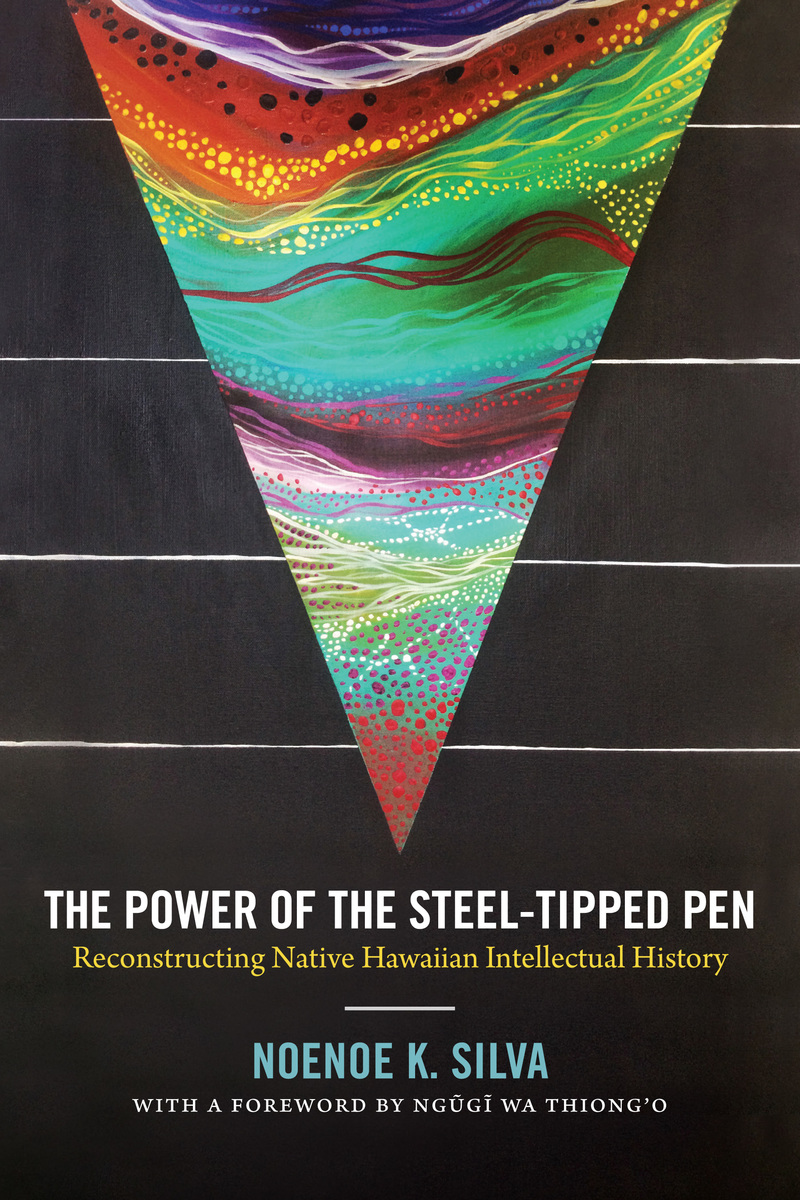
The Power of the Steel-tipped Pen: Reconstructing Native Hawaiian Intellectual History
The Power of the Steel-tipped Pen: Reconstructing Native Hawaiian Intellectual History
by Noenoe K. Silva
foreword by Ngugi Wa Thiong'o
Duke University Press, 2017
ISBNs
Cloth: 978-0-8223-6352-1
Paper: 978-0-8223-6368-2
eISBN: 978-1-4780-9404-3 (OA)
eISBN: 978-0-8223-7313-1 (standard)
About the Book
In The Power of the Steel-tipped Pen Noenoe K. Silva reconstructs the indigenous intellectual history of a culture where—using Western standards—none is presumed to exist. Silva examines the work of two lesser-known Hawaiian writers—Joseph Ho‘ona‘auao Kānepu‘u (1824–ca. 1885) and Joseph Moku‘ōhai Poepoe (1852–1913)—to show how the rich intellectual history preserved in Hawaiian-language newspapers is key to understanding Native Hawaiian epistemology and ontology. In their newspaper articles, geographical surveys, biographies, historical narratives, translations, literatures, political and economic analyses, and poetic works, Kānepu‘u and Poepoe created a record of Hawaiian cultural history and thought in order to transmit ancestral knowledge to future generations. Celebrating indigenous intellectual agency in the midst of US imperialism, The Power of the Steel-tipped Pen is a call for the further restoration of native Hawaiian intellectual history to help ground contemporary Hawaiian thought, culture, and governance.
About the Author
Noenoe K. Silva is Professor of Indigenous Politics at the University of Hawai‘i at Mānoa and author of Aloha Betrayed: Native Hawaiian Resistance to American Colonialism, also published by Duke University Press.
Ngũgĩ wa Thiong’o is the author of numerous works of fiction, poetry, plays, and criticism, most recently, Birth of a Dream Weaver.
Ngũgĩ wa Thiong’o is the author of numerous works of fiction, poetry, plays, and criticism, most recently, Birth of a Dream Weaver.
Reviews
-- Cristina Bacchilega Journal of American History
-- Kealani Cook Journal of Pacific History
-- Emalani Case European Journal of American Culture
-- Hi‘ilei Julia Hobart Contemporary Pacific
-- Natchee Blu Barnd American Indian Culture and Research Journal
-- Leah Kuragano Journal of American Studies
-- David A. Chang Native American and Indigenous Studies
“A must-read for anyone interested in Hawaiian intellectual history and indigenous studies, this book results from amazing research and work that do not, however, weigh on Silva’s clear and cogent writing.”
-- Cristina Bacchilega Journal of American History
"The Power of the Steel-tipped Pen is the most in-depth exploration of Native Hawaiian intellectual history to be published to date. . . . [It] is likely to join Aloha Betrayed as part of the modern canon of Hawaiian history, as well as provide a potential model for Indigenous intellectual histories in Oceania and elsewhere."
-- Kealani Cook Journal of Pacific History
“Noenoe K. Silva’s work provides readers with a deeply meaningful way of studying the past in relation to the present and future. . . . Deeply motivating.”
-- Emalani Case European Journal of American Culture
“The Power of the Steel-Tipped Pen offers a master class on how to use an archive. Required reading for anyone interested in the fields of Hawaiian history or Hawaiian studies.”
-- Hi‘ilei Julia Hobart Contemporary Pacific
"Any reader with an interest in indigenous studies will find this text offering several valuable methodological lessons as well as a wonderful example of a community-centered scholarship of practice."
-- Natchee Blu Barnd American Indian Culture and Research Journal
"Noenoe K. Silva (Kanaka Hawai‘i) has published another brilliant and much-needed contribution to several scholarly fields, including intellectual history, indigenous studies, and Hawaiian historiography. . . . This project not only serves to add nuance to scholarly understandings of Hawaii’s history by considering the often-ignored archive of Hawaiian-language texts, but, more importantly, contributes to the indigenous sovereignty movement in Hawaii."
-- Leah Kuragano Journal of American Studies
"A compelling and erudite book whose linguistic and methodological range demonstrates that dedication to Indigenous futures is deeply rooted in Native Hawaiian intellectual history. . . [The Power of the Steel-Tipped Pen] powerfully brings together close readings, biographical study, and historical contextualization. Silva has produced a major work that demands the attention of all readers committed to Hawaiian history, Hawaiian literature, and Hawaiian studies."
-- David A. Chang Native American and Indigenous Studies
Tags
Hawaiian literature, 1852-1913, Hawaiian language, Colonialism & Post-Colonialism, Power, Sources, West (AK CA CO HI ID MT NV UT WY), Native American Studies, Influence, Intellectual life, 19th century, Social aspects, State & Local, History and criticism, Political Science, United States, Social Science, History
Open Access Information
Label: University of Hawai'i
License: CC BY-NC-ND 4.0

 Loading...