
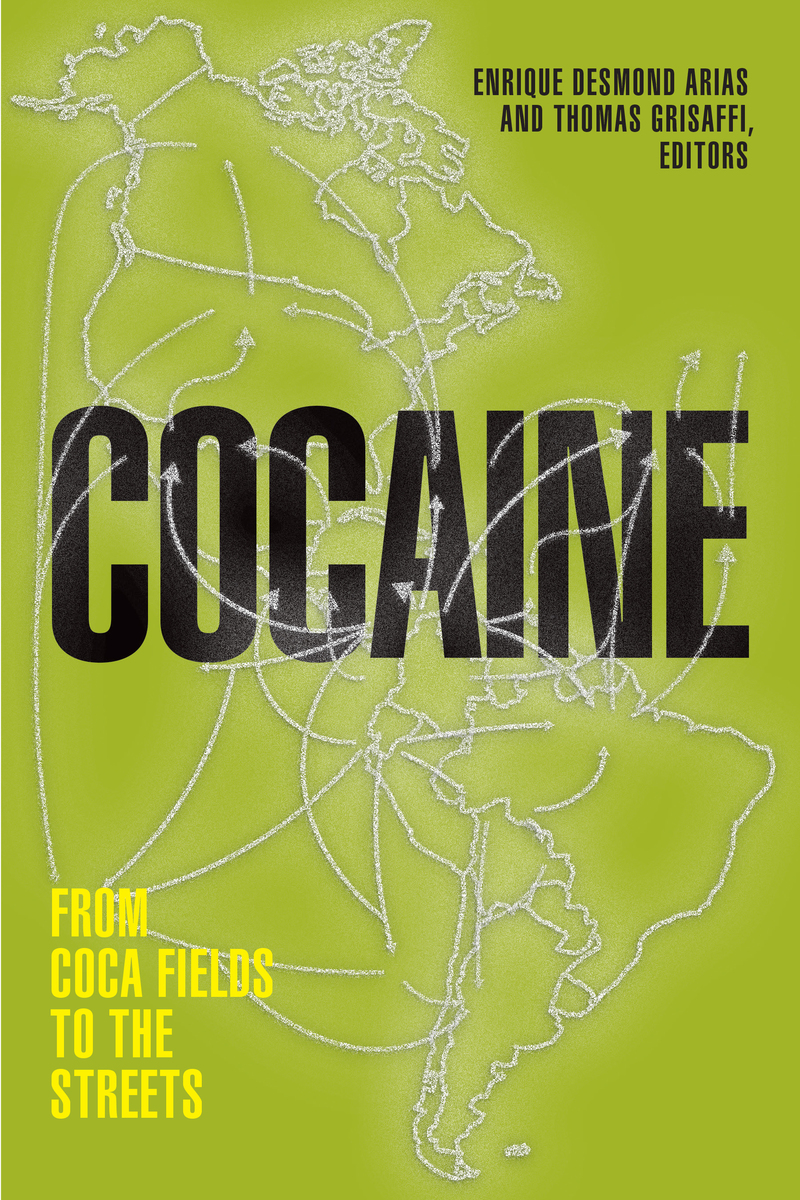
Cocaine: From Coca Fields to the Streets
Cocaine: From Coca Fields to the Streets
edited by Enrique Desmond Arias and Thomas Grisaffi
Duke University Press, 2021
ISBNs
Cloth: 978-1-4780-1372-3
Paper: 978-1-4780-1465-2
eISBN: 978-1-4780-9232-2 (OA)
eISBN: 978-1-4780-2195-7 (standard)
About the Book
The contributors to Cocaine analyze the contemporary production, transit, and consumption of cocaine throughout the Americas and the illicit economy's entanglement with local communities. Based on in-depth interviews and archival research, these essays examine how government agents, acting both within and outside the law, and criminal actors seek to manage the flow of illicit drugs to both maintain order and earn profits. Whether discussing the moral economy of coca cultivation in Bolivia, criminal organizations and drug traffickers in Mexico, or the routes cocaine takes as it travels into and through Guatemala, the contributors demonstrate how entire ways of life are built around cocaine commodification. They consider how the authority of state actors is coupled with the self-regulating practices of drug producers, traffickers, and dealers, complicating notions of governance and of the relationships between economic and moral economies. The collection also outlines a more progressive drug policy that acknowledges the important role drugs play in the lives of those at the urban and rural margins.
Contributors. Enrique Desmond Arias, Lilian Bobea, Philippe Bourgois, Anthony W. Fontes, Robert Gay, Paul Gootenberg, Romain Le Cour Grandmaison, Thomas Grisaffi, Laurie Kain Hart, Annette Idler, George Karandinos, Fernando Montero, Dennis Rodgers, Taniele Rui, Cyrus Veeser, Autumn Zellers-León
Contributors. Enrique Desmond Arias, Lilian Bobea, Philippe Bourgois, Anthony W. Fontes, Robert Gay, Paul Gootenberg, Romain Le Cour Grandmaison, Thomas Grisaffi, Laurie Kain Hart, Annette Idler, George Karandinos, Fernando Montero, Dennis Rodgers, Taniele Rui, Cyrus Veeser, Autumn Zellers-León
About the Author
Enrique Desmond Arias is Marxe Chair of Western Hemisphere Affairs and Professor, Baruch College and the Graduate Center, City University of New York. He is the author of Criminal Enterprises and Governance in Latin America and the Caribbean.
Thomas Grisaffi is Associate Professor of Human Geography at the University of Reading and author of Coca Yes, Cocaine No: How Bolivia’s Coca Growers Reshaped Democracy, also published by Duke University Press.
Thomas Grisaffi is Associate Professor of Human Geography at the University of Reading and author of Coca Yes, Cocaine No: How Bolivia’s Coca Growers Reshaped Democracy, also published by Duke University Press.
Reviews
-- Rivke Jaffe, author of Concrete Jungles: Urban Pollution and the Politics of Difference in the Caribbean
-- Graham Denyer Willis, author of The Killing Consensus: Police, Organized Crime, and the Regulation of Life and Death in Urban Brazil
-- Molly C. Ball HAHR
-- Jane Rausch Journal of Global South Studies
-- Onur Agkaya Bulletin of Latin American Research
“Through its attention to both the transnational cocaine commodity chain and the locally specific moral economies that have developed along it, Cocaine presents an innovative and urgent perspective. This highly original and engaging volume makes significant contributions to studies of crime, governance, economics, and Latin American studies.”
-- Rivke Jaffe, author of Concrete Jungles: Urban Pollution and the Politics of Difference in the Caribbean
“A beautifully curated collection of rich and nuanced work surrounding cocaine, this outstanding book should be read across disciplines by policy makers, geographers, sociologists, anthropologists, historians, and sensible political scientists.”
-- Graham Denyer Willis, author of The Killing Consensus: Police, Organized Crime, and the Regulation of Life and Death in Urban Brazil
"That rarest of edited volumes, one that genuinely changes the field, maintains structure and coherence, and never drifts into repetitiveness."
-- Molly C. Ball HAHR
"Cocaine offers new insights into the impact of narcotics in Latin America. It is an authoritative, interdisciplinary collection of studies geared to policy makers, social scientists, and historians that will undoubtedly strengthen their understanding of this complex subject."
-- Jane Rausch Journal of Global South Studies
"Cocaine reaches the goal of providing ‘a new way of thinking about the interconnections that operate in the cocaine trade’ by meticulously articulating a coherent conceptual and theoretical model of ‘the moral economy of the cocaine’ to understand the trade and its impacts in Latin America and the globe. ... An insightful resource for researchers observing drug trafficking and those interested in Latin American modern history."
-- Onur Agkaya Bulletin of Latin American Research
"Cocaine is a well-written book, with each chapter providing much to think about concerning the moral economy of the drug trade."
-- William L. Marcy The Latin Americanist
-- William L. Marcy The Latin Americanist
Tags
Cocaine industry, Coca industry, Cocaine, Latin America, Sociology, Cultural & Social, Social aspects, Anthropology, United States, Social Science, History
Open Access Information
License: CC BY-NC-ND 4.0

 Loading...