
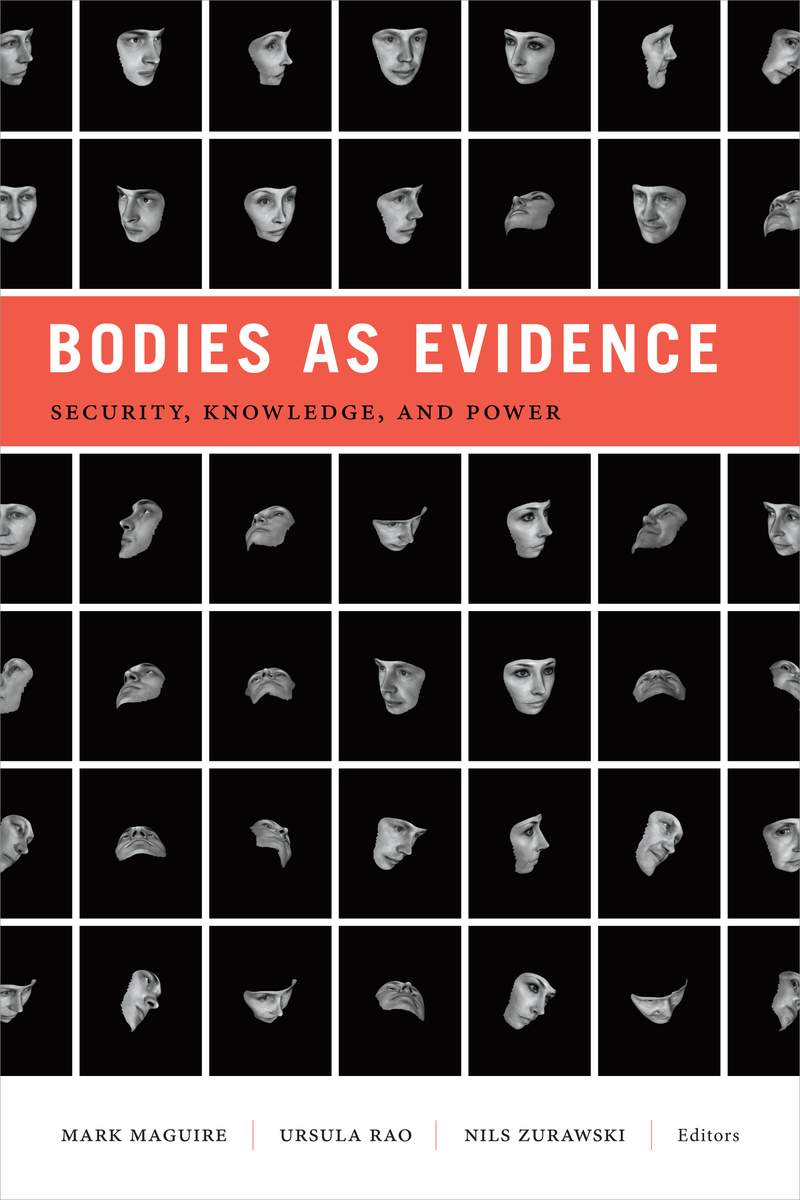
Bodies as Evidence: Security, Knowledge, and Power
Bodies as Evidence: Security, Knowledge, and Power
edited by Mark Maguire, Ursula Rao and Nils Zurawski
Duke University Press, 2018
ISBNs
Cloth: 978-1-4780-0169-0
Paper: 978-1-4780-0294-9
eISBN: 978-1-4780-9164-6 (OA)
eISBN: 978-1-4780-0430-1 (standard)
About the Book
From biometrics to predictive policing, contemporary security relies on sophisticated scientific evidence-gathering and knowledge-making focused on the human body. Bringing together new anthropological perspectives on the complexities of security in the present moment, the contributors to Bodies as Evidence reveal how bodies have become critical sources of evidence that is organized and deployed to classify, recognize, and manage human life. Through global case studies that explore biometric identification, border control, forensics, predictive policing, and counterterrorism, the contributors show how security discourses and practices that target the body contribute to new configurations of knowledge and power. At the same time, margins of error, unreliable technologies, and a growing suspicion of scientific evidence in a “post-truth” era contribute to growing insecurity, especially among marginalized populations.
Contributors. Carolina Alonso-Bejarano, Gregory Feldman, Francisco J. Ferrándiz, Daniel M. Goldstein, Ieva Jusionyte, Amade M’charek, Mark Maguire, Joseph P. Masco, Ursula Rao, Antonius C. G. M. Robben, Joseba Zulaika, Nils Zurawski
Contributors. Carolina Alonso-Bejarano, Gregory Feldman, Francisco J. Ferrándiz, Daniel M. Goldstein, Ieva Jusionyte, Amade M’charek, Mark Maguire, Joseph P. Masco, Ursula Rao, Antonius C. G. M. Robben, Joseba Zulaika, Nils Zurawski
About the Author
Mark Maguire is Senior Lecturer of Anthropology and Dean of the Faculty of Social Sciences at Maynooth University.
Ursula Rao is Professor of Anthropology at the University of Leipzig.
Nils Zurawski is Senior Researcher and Visiting Professor in the Department of Social Sciences at the University of Hamburg.
Maguire and Zurawski are coeditors of The Anthropology of Security: Perspectives from the Frontline of Policing, Counterterrorism, and Border Control. Rao is author of News as Culture: Journalistic Practices and the Remaking of Indian Leadership Traditions.
Ursula Rao is Professor of Anthropology at the University of Leipzig.
Nils Zurawski is Senior Researcher and Visiting Professor in the Department of Social Sciences at the University of Hamburg.
Maguire and Zurawski are coeditors of The Anthropology of Security: Perspectives from the Frontline of Policing, Counterterrorism, and Border Control. Rao is author of News as Culture: Journalistic Practices and the Remaking of Indian Leadership Traditions.
Reviews
-- Monika Weissensteiner Surveillance Studies
-- Sarah Maya Rosen Journal of International & Global Studies
-- Emily C. Kaufman Social & Cultural Geography
"The volume certainly highlights what a conceptual anthropological engagement with 'security,' as well as with 'evidence' means. The volume will be worth reading for scholars in- and out-side anthropology interested in the production of knowledge, technologies, security and governmentality."
-- Monika Weissensteiner Surveillance Studies
“Bodies as Evidence poses a bold premise. It argues that not only is evidence beholden to social and political influences but that the glorification of evidence has demonstrable, and often dangerous, side effects on already marginalized communities. Its exemplary use of ethnographic and reflexive methodologies illustrates the vast complexity of seemingly objective data, and the practical limitations of collecting and employing it.”
-- Sarah Maya Rosen Journal of International & Global Studies
“This timely book will be of interest to political, legal, and social geographers concerned with the embodied and spatial implications of shifting laws and borders, and demands for evidence by and against the state.”
-- Emily C. Kaufman Social & Cultural Geography
Tags
Global Insecurities, Security, Evidence, Bodies, Crime prevention, Border security, Biometric identification, Knowledge, Power, Sociology, Cultural & Social, Anthropology, Social Science
Open Access Information
License: CC BY-NC-ND 4.0

 Loading...