
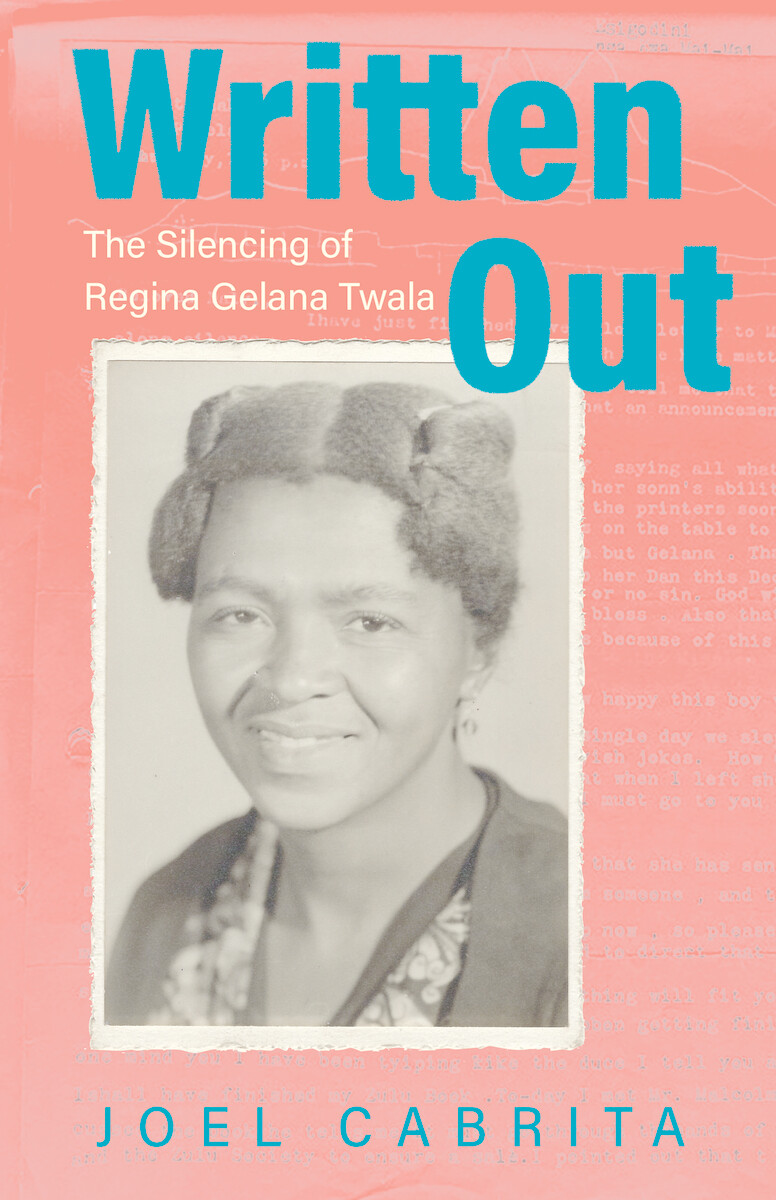
Written Out: The Silencing of Regina Gelana Twala
Written Out: The Silencing of Regina Gelana Twala
by Joel Cabrita
Ohio University Press, 2023
ISBNs
Paper: 978-0-8214-2507-7
eISBN: 978-0-8214-4789-5
About the Book
Systemic racism and sexism caused one of South Africa’s most important writers to disappear from public consciousness. Is it possible to justly restore her historical presence? Regina Gelana Twala, a Black South African woman who died in 1968 in Swaziland (now Eswatini), was an extraordinarily prolific writer of books, columns, articles, and letters. Yet today Twala’s name is largely unknown. Her literary achievements are forgotten. Her books are unpublished. Her letters languish in the dusty study of a deceased South African academic. Her articles are buried in discontinued publications. Joel Cabrita argues that Twala’s posthumous obscurity has not developed accidentally as she exposes the ways prejudices around race and gender blocked Black African women like Twala from establishing themselves as successful writers. Drawing upon Twala’s family papers, interviews, newspapers, and archival records from Pretoria, Uppsala, and Los Angeles, Cabrita argues that an entire cast of characters—censorious editors, territorial White academics, apartheid officials, and male African politicians whose politics were at odds with her own—conspired to erase Twala’s legacy. Through her unique documentary output, Twala marked herself as a radical voice on issues of gender, race, and class. The literary gatekeepers of the racist and sexist society of twentieth-century southern Africa clamped down by literally writing her out of the region’s history. Written Out also scrutinizes the troubled racial politics of African history as a discipline that has been historically dominated by White academics, a situation that many people within the field are now examining critically. Inspired by this recent movement, Cabrita interrogates what it means for her—a White historian based in the Northern Hemisphere—to tell the story of a Black African woman. Far from a laudable “recovery” of an important lost figure, Cabrita acknowledges that her biography inevitably reproduces old dynamics of White scholarly privilege and dominance. Cabrita’s narration of Twala’s career resurrects it but also reminds us that Twala, tragically, is still not the author of her own life story.
About the Author
Joel Cabrita is Susan Ford Dorsey Director of the Center for African Studies and an associate professor of African history at Stanford University, and a senior research associate in the Department of Historical Studies at the University of Johannesburg. Her work focuses on religion, gender, and the politics of knowledge production in Africa and globally. She is the author of Text and Authority in the South African Nazaretha Church and The People’s Zion: Southern Africa, the United States, and a Transatlantic Faith-Healing Movement.
Reviews
“An honest, sensitive portrayal of a complex, determined woman who deserves recognition.”—Library Journal
“Joel Cabrita’s Written Out: The Silencing of Regina Gelana Twala is that extraordinary work of restoration that restores not just the historical subject herself, but Twala’s entire social milieu. This then allows us to contemplate the vicissitudes of her life and the processes by which she came to her life choices in great and intimate detail. Cabrita has given us an exemplary historical biography that will have ramifications well beyond the boundaries of African history itself.”—Ato Quayson, Jean G. and Morris M. Doyle Professor in Interdisciplinary Studies and professor of English at Stanford University
“A marvelously clever biography. Cabrita tells the story of Regina Twala’s life while simultaneously writing the tale of her erasure. What a bold, ambitious, and necessary project. Twala’s life is rendered in technicolor and so too are the processes that almost buried her bright, shining light. An important and beautifully told tale of ‘sanctioned forgetting,’ and glorious remembering.”—Sisonke Msimang, author of The Resurrection of Winnie Mandela
Tags
Anti-apartheid activists, South Africa, South, Historiography, Africa, Social life and customs, Women, Social conditions, Biography, Biography & Autobiography, 20th century, History
Open Access Information
Label: Open access available
License: CC BY-NC-ND 4.0

 Loading...