
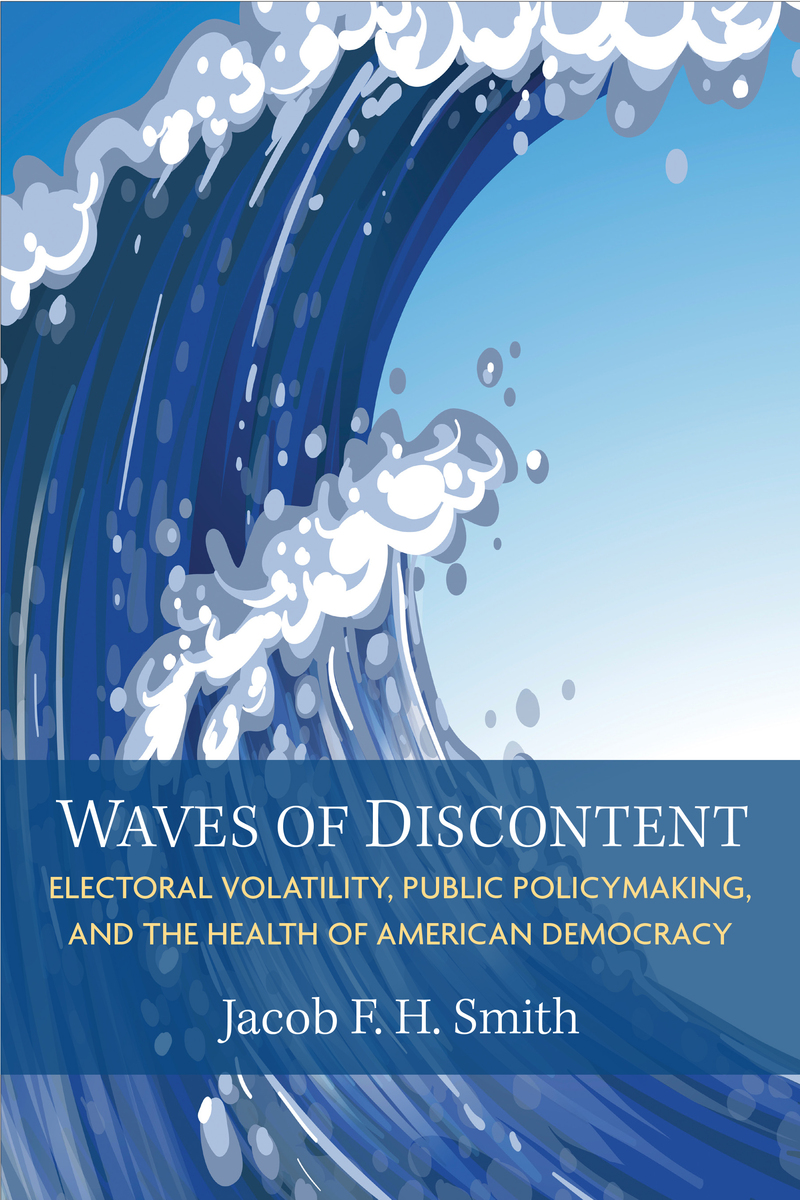
Waves of Discontent: Electoral Volatility, Public Policymaking, and the Health of American Democracy
Waves of Discontent: Electoral Volatility, Public Policymaking, and the Health of American Democracy
by Jacob F. H. Smith
University of Michigan Press, 2025
ISBNs
Cloth: 978-0-472-07780-9
Paper: 978-0-472-05780-1
eISBN: 978-0-472-90538-6 (OA)
About the Book
After a period of relative calm in congressional elections prior to 2006, America has experienced a series of highly competitive, volatile national elections. Since then, at least one of the US House, US Senate, and presidency has flipped party control—often with a large House or Senate seat swing—with the exception of the 2012 election. In Waves of Discontent, Jacob F. H. Smith argues that a pervasive feeling of displeasure in the American public has caused this increase in electoral volatility.
Conducting statistical analyses of a wide array of surveys, Smith found that these feelings of displeasure translate to lower turnout among voters from the president’s party and a higher percentage of independents voting for the other party. Subsequently, he conducted a content analysis of New York Times articles to look at the connection between unrest in American society and seat swings in congressional elections, even before the existence of polling. Examining the consequences of volatility in congressional elections reveals that political amateurs are more likely to win in wave years than in normal years. Based on this data, Smith presents a new theory about the policy process—the policy doom loop—in which frustration among voters at both the inability of Congress to pass policy and anger at policies that actually do pass results in even more churn in congressional elections. Waves of Discontent offers some suggestions to promote constructive policymaking efforts in Washington to reduce frustration in the electorate.
Conducting statistical analyses of a wide array of surveys, Smith found that these feelings of displeasure translate to lower turnout among voters from the president’s party and a higher percentage of independents voting for the other party. Subsequently, he conducted a content analysis of New York Times articles to look at the connection between unrest in American society and seat swings in congressional elections, even before the existence of polling. Examining the consequences of volatility in congressional elections reveals that political amateurs are more likely to win in wave years than in normal years. Based on this data, Smith presents a new theory about the policy process—the policy doom loop—in which frustration among voters at both the inability of Congress to pass policy and anger at policies that actually do pass results in even more churn in congressional elections. Waves of Discontent offers some suggestions to promote constructive policymaking efforts in Washington to reduce frustration in the electorate.
About the Author
Jacob F. H. Smith is Assistant Professor of Political Science at Fordham University.
Reviews
“Overall, Smith makes a compelling case, highlighting the pivotal role of independent voters, though the deeper structural roots of discontent receive less attention. Waves of Discontent is well suited for collections on American politics.”
— D. Schultz, Choice“Overall, Smith makes a compelling case, highlighting the pivotal role of independent voters, though the deeper structural roots of discontent receive less attention. Waves of Discontent is well suited for collections on American politics.”
— D. Schultz, Choice“Jacob Smith identifies an explanation for an important feature of modern politics: electoral volatility. Using historical and contemporary evidence, he links this phenomenon to political dissatisfaction, diagnosing an important problem in our politics and offering ideas for solutions.”— Julia R. Azari, Marquette University
“Jacob Smith’s study provides invaluable tools for measuring and understanding electoral volatility. His useful comparisons with the late nineteenth century makes this an important study for students of that period. But more importantly, he aspires to provide an explanation for its pervasiveness in our time, and his conclusions—troubling as they are—must be reckoned with by all students of current American politics.”— Daniel Klinghard, College of the Holy Cross
Tags
Legislative Politics And Policy Making, Policy sciences, Waves, Political stability, Discontent, Political participation, Political Process, Democracy, American Government, Politics and government, Political Science, United States
Open Access Information
License: CC BY-NC

 Loading...