
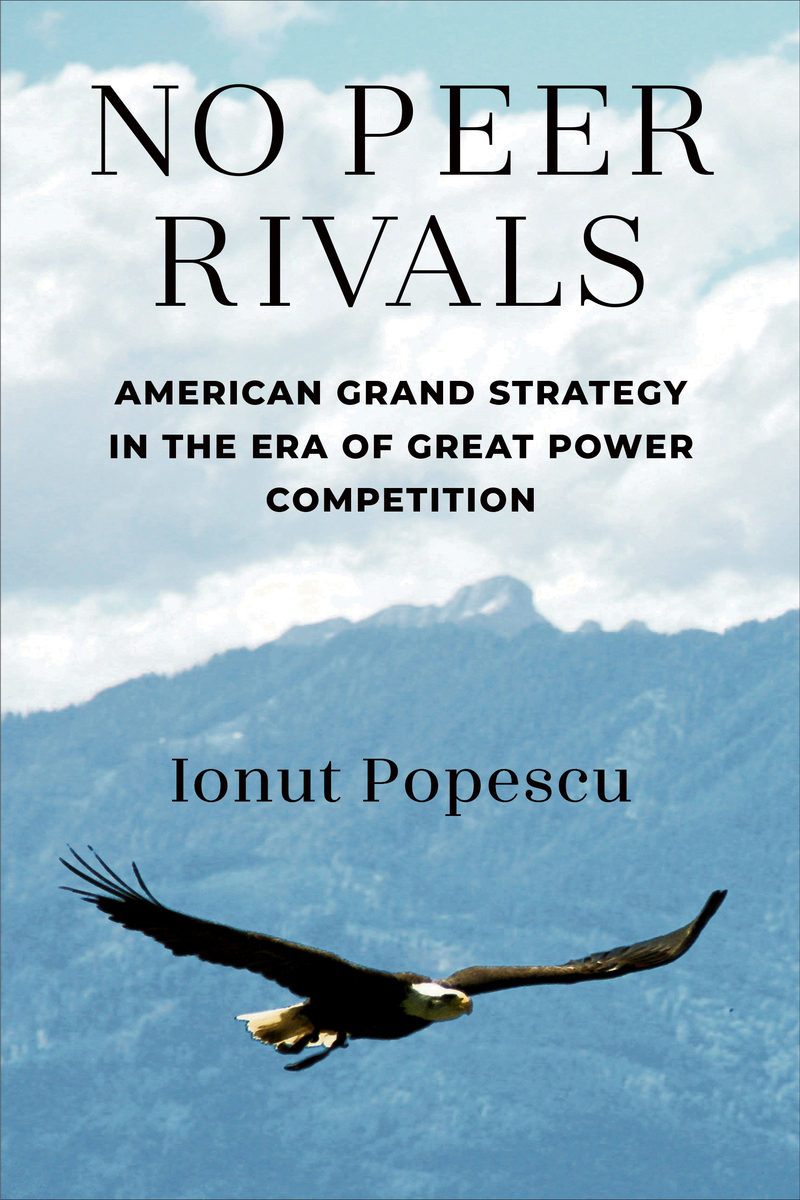
No Peer Rivals: American Grand Strategy in the Era of Great Power Competition
No Peer Rivals: American Grand Strategy in the Era of Great Power Competition
by Ionut Popescu
University of Michigan Press, 2025
ISBNs
Cloth: 978-0-472-07739-7
Paper: 978-0-472-05739-9
eISBN: 978-0-472-90499-0 (OA)
About the Book
With military maneuvers in Taiwan and the South China Sea and the eruption of war in Ukraine, the past few years have brought deteriorating diplomatic relations and increasing military and economic tensions between the United States, China, and Russia. After benefiting from the geopolitical and financial advantages conferred by a privileged status as a global superpower for three decades, the United States needs to adapt to a geopolitical shift toward competition and confrontation in order to contain China’s quest for global superpower status.
No Peer Rivals takes a major staple of International Relations scholarship—the offensive realist paradigm—and develops a comprehensive and practical grand strategy for the United States in this new era of Great Power Competition. The No Peer Rival framework is grounded in a realistic assessment of the most likely courses of action adopted by China, Russia, and other important regional powers. It prioritizes great power rivalry over other strategic goals, and identifies China as the biggest threat to America’s unique position in the international system. This grand strategic approach carefully aligns the domestic sources of national power (economic strength, energy security, and technological prowess) to America’s foreign policy and national security objectives. In addition to recommending necessary changes to America’s military and diplomatic strategies, No Peer Rivals also demonstrates that a realistic approach to industrial policy, international trade, energy production, and technological superiority offers the best chance for developing the sinews of power needed to outcompete Beijing in the long run.
No Peer Rivals takes a major staple of International Relations scholarship—the offensive realist paradigm—and develops a comprehensive and practical grand strategy for the United States in this new era of Great Power Competition. The No Peer Rival framework is grounded in a realistic assessment of the most likely courses of action adopted by China, Russia, and other important regional powers. It prioritizes great power rivalry over other strategic goals, and identifies China as the biggest threat to America’s unique position in the international system. This grand strategic approach carefully aligns the domestic sources of national power (economic strength, energy security, and technological prowess) to America’s foreign policy and national security objectives. In addition to recommending necessary changes to America’s military and diplomatic strategies, No Peer Rivals also demonstrates that a realistic approach to industrial policy, international trade, energy production, and technological superiority offers the best chance for developing the sinews of power needed to outcompete Beijing in the long run.
About the Author
Ionut Popescu is Professor of Political Science at Texas State University.
Reviews
"In this timely book, Popescu provides a prescription for US grand strategy based on the scholastic theory of offensive realism...Logically presented and well sourced with numerous citations from leading policy journals, the book is valuable for both undergraduates being introduced to strategic studies and graduate students sharpening their analytical skills, irrespective of the reader's agreement with the policies this book offers. Summing up: Highly recommended. General readers through faculty; professionals."— Choice
“Popescu has made a major contribution to the American grand strategy debate. He rigorously draws out from offensive realism a comprehensive approach for ensuring that China does not out-compete the United States in the miliary, economic, and diplomatic realms. The book should be widely read in academic and policy circles.”
— John Schuessler, Perspectives on Politics“No Peer Rivals by Ionut Popescu is a highly original application of the offensive realism social science theory into a comprehensive and practical grand strategy for the United States. It argues that offensive realism is superior to the possible grand strategic alternatives (defensive realism, liberal internationalism, and conservative internationalism) and then explains how offensive realism would apply in the areas of defense, economics, and alliances. There is much to like about the book, including the tight conceptual framework and the detailed and well-researched empirical work on the new era of great power rivalry. It makes an important contribution to both scholarly and policy debates.”— Matthew Kroenig, Georgetown University
“Popescu is a talented young scholar who skillfully uses realist theory to explain how great powers should think about grand strategy in today’s multipolar world. No Peer Rivals is full of smart insights about a truly important subject.”— John J. Mearsheimer, University of Chicago
Tags
American Grand Strategy, Great Power Competition, Capitalism, Foreign relations, International Relations, China, Political Ideologies, 21st century, Political Science, United States
Open Access Information
License: CC BY-NC

 Loading...