
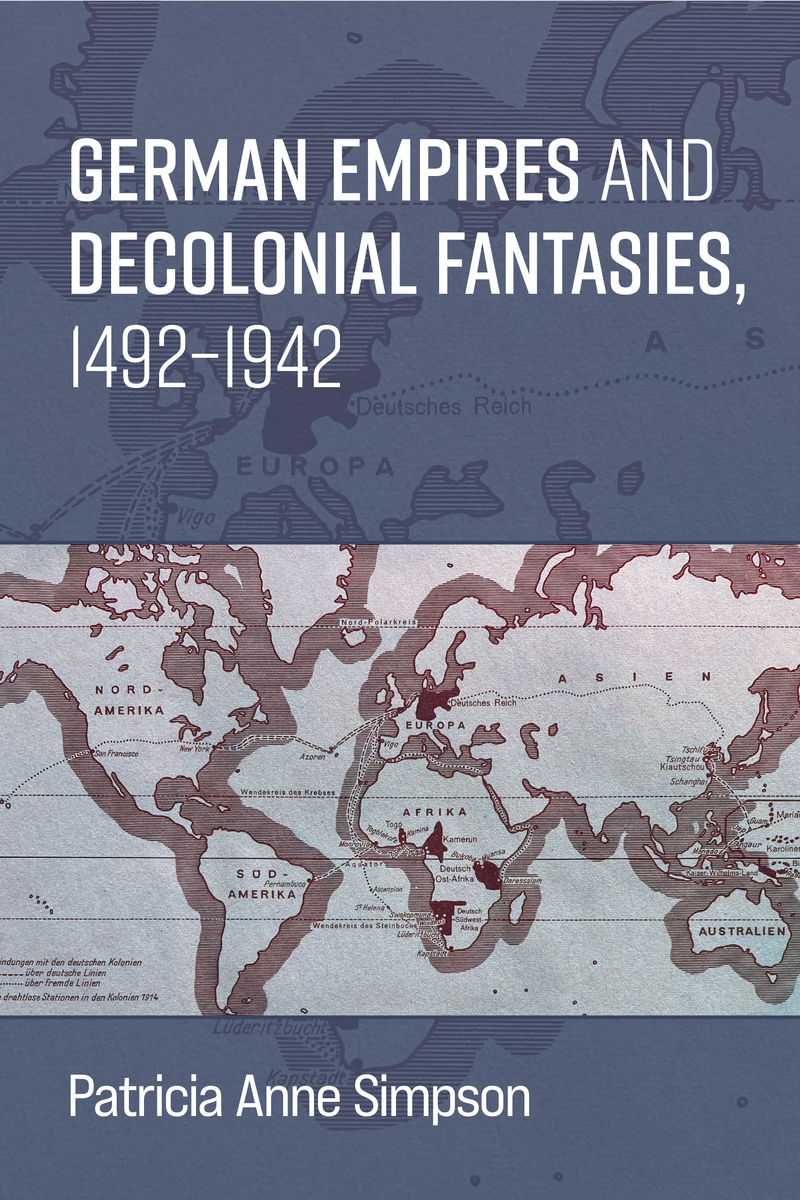
German Empires and Decolonial Fantasies, 1492–1942
German Empires and Decolonial Fantasies, 1492–1942
by Patricia Anne Simpson
University of Michigan Press, 2025
ISBNs
Cloth: 978-0-472-07737-3
Paper: 978-0-472-05737-5
eISBN: 978-0-472-90497-6 (OA)
About the Book
German Empires and Decolonial Fantasies, 1492–1942 investigates the ways German-speaking Europe’s cultural narratives reflect histories of entanglement with the colonial world. Drawing from an impressive range of sources, Patricia Anne Simpson decodes the ironclad colonial logic that reproduces and inflects tropes of the conquistador, scientific explorer, and pioneers. She brings them into dialogue with a cast of historical agents who reimagine the cannibal, the enslaved, the conquered, Indigenous interlocutors, and the ungovernable. Throughout, intersectional attributes of race, gender, ethnicity, and religion reconfigure around shades of European whiteness. Individual chapters explore the Hohenzollern legacy in early modernity; debates about sovereignty and enslavement; recruitment literature, prose and fiction about migration and colonization in Africa and the Americas; and colonial memoirs driven by recolonial fantasies after 1918. German Empires and Decolonial Fantasies advances efforts to decolonize the multiple disciplines that intersect the field of German studies, including literary criticism, history, philosophy, art history, and anthropology.
German Empires and Decolonial Fantasies, 1492–1942 draws from a wide range of sources, from a seventeenth-century Brandenburg fort on the coast of Ghana to a novella about a beleaguered colonial administrator in German East Africa, to advance an interdisciplinary discourse at the nexus of colonial narratives and national imaginaries. Through detailed case studies, Simpson argues for the inclusion of voices that pushed back against imperialist expansion or intervention, as well as those historical actors who disputed the supremacy of whiteness and the persuasive power of German-centric national history.
German Empires and Decolonial Fantasies, 1492–1942 draws from a wide range of sources, from a seventeenth-century Brandenburg fort on the coast of Ghana to a novella about a beleaguered colonial administrator in German East Africa, to advance an interdisciplinary discourse at the nexus of colonial narratives and national imaginaries. Through detailed case studies, Simpson argues for the inclusion of voices that pushed back against imperialist expansion or intervention, as well as those historical actors who disputed the supremacy of whiteness and the persuasive power of German-centric national history.
About the Author
Patricia Anne Simpson is Professor of German at the University of Nebraska–Lincoln.
Reviews
"Simpson's brilliant literary prose and thorough analysis of German colonial history on the African continent and in the Americas make for impressive scholarship. . . . Throughout, Simpson makes complex ideas accessible without sacrificing scholarly precision."— Lawrence Mello, Library Journal
“Stretching over nearly 500 years and across much of the globe, Simpson makes a compelling case that the history of German speakers is inextricably linked to—and not infrequently shaped by—a colonial world order. The book will propel forward discourses on German history, migration, and the role of Germans in the world from 1492 to 1942 and signals a new phase of German studies, in which the full complexity of German colonial projects, patterns of mobility, and immigrants themselves is in focus. Simpson urges us to question the authority of nation-state narratives, a perspective that will resonate across academic disciplines beyond German studies.”— Robert Kelz, University of Memphis
“Ranging widely across space, time, and a great variety of sources, Patricia Simpson demonstrates through her deft analysis of narratives about German migration and settlement how to decolonize even precolonial and postcolonial narratives. Theoretically sophisticated and clearly argued, her study deserves wide readership, and it is certain to spark debate.”— Glenn Penny, University of California, Los Angeles
“In German Empires and Decolonial Fantasies, 1492–1942, Simpson shows how the interplay between historical documents and literary texts forged powerful narratives defying and reiterating, obscuring and embellishing the logic of colonialism. In the process, she unearths fascinating material objects and the stories they tell while never losing sight of voices ‘unarchived,’ erased, and eclipsed and reimagining their presence wherever possible.”— Birgit Tautz, Bowdoin College
“Spanning five centuries, Simpson uses literature, philosophy, political and religious texts, and historical narratives to show the danger of colonialist dreams embedded in exploration, migration schemes, and knowledge itself.”— Benjamin Bryce, University of British Columbia
Tags
Social History, Popular Culture, And Politics In Germany, Colonies in literature, Foreign influences, Europe German-speaking, National characteristics German, Imperialism, Colonies, Colonialism & Post-Colonialism, Germany, Civilization, Europe, Political Science, History
Open Access Information
License: CC BY-NC

 Loading...