
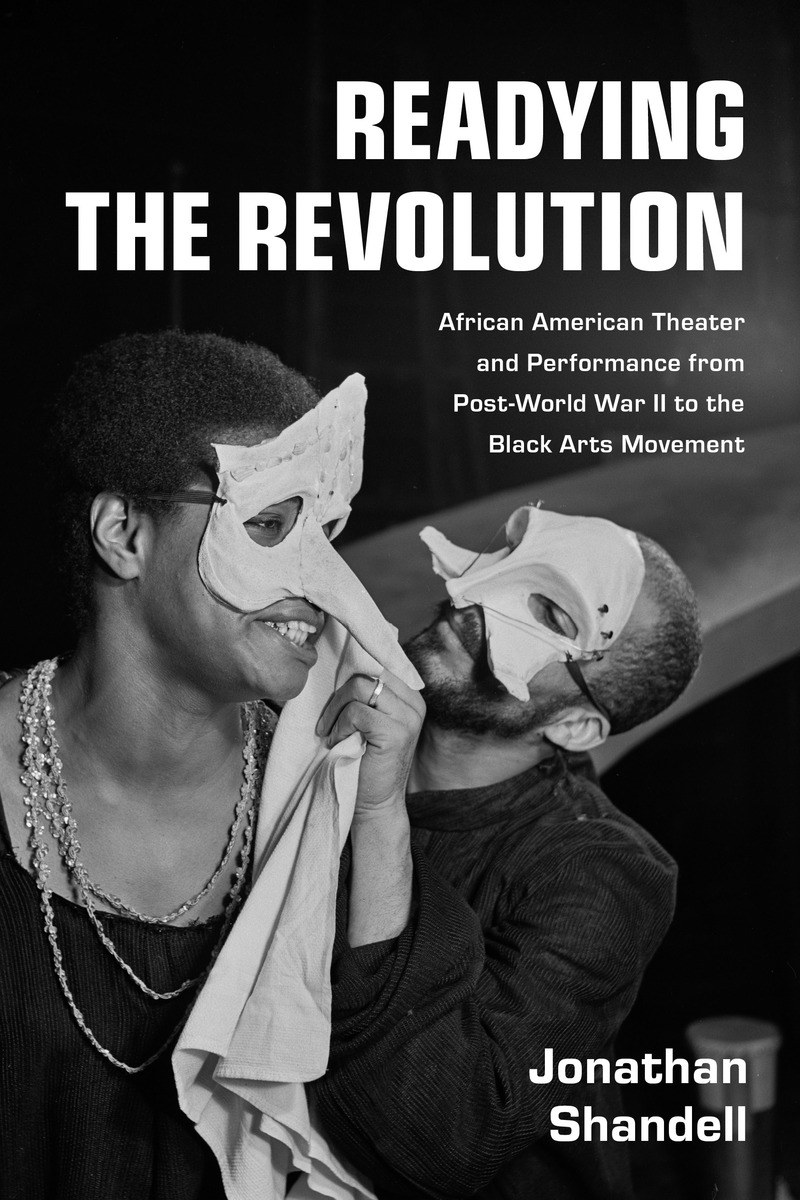
Readying the Revolution: African American Theater and Performance from Post-World War II to the Black Arts Movement
Readying the Revolution: African American Theater and Performance from Post-World War II to the Black Arts Movement
by Jonathan Shandell
University of Michigan Press, 2025
ISBNs
Cloth: 978-0-472-07718-2
Paper: 978-0-472-05718-4
eISBN: 978-0-472-90480-8 (OA)
About the Book
Starting in 1966, African American activist Stokely Carmichael and other political leaders adopted the phrase "Black Power!" The slogan captured a militant, revolutionary spirit that was already emerging in the work of playwrights, poets, musicians, and visual artists throughout the Black Arts movement of the mid-1960s. But the story of those theater artists and performers whose work helped bring about the Black Arts revolution has not fully been told. Readying the Revolution: African American Theater and Performance from Post-World War II to the Black Arts Movement explores the dynamic era of Black culture between the end of World War II and the start of the Black Arts Movement (1946-1964) by illuminating how artists and innovators such as Jackie Robinson, Lorraine Hansberry, Ossie Davis, Nina Simone, and others helped radicalize Black culture and Black political thought. In doing so, these artists defied white cultural hegemony in the United States, and built the foundation for the revolutionary movement in Black theater that followed in the mid 1960s. Through archival research, close textual reading, and an analysis of performance artifacts, Shandell demonstrates how these artists negotiated a space on the public stage for cultivating radical Black aesthetics and built the foundation for the revolutionary movement in Black theater that followed in the mid-1960s.
About the Author
Jonathan Shandell is Associate Professor of Theater Arts at Arcadia University.
Reviews
"This book makes a valuable contribution to scholarship that reconsiders the cultural and political itineraries of black life in the wake of World War II. Though opening with Lorraine Hansberry, it prioritizes the voices of little-known black plays and playwrights. Anchoring his study in this undercommons of black theatre workers, Shandell tells an exciting and convincing story about the importance of black theatre (and performance more broadly) to the varied and various radicalisms that saturated and exploded the worlds that were, and that strained to create the worlds that could be."
— Julius Fleming, University of Maryland
— Julius Fleming, University of Maryland
“Explores a range of Black plays, performers, and artists whose ‘radical creativity’ connects the radical left culture of the 1930s with the militancy of Black Power in the 1960s. The book’s exciting interdisciplinary scope allows the author to build on and expand existing scholarship that has long sought to trouble the periodization and disciplinary boundaries of the Civil Rights and Black Power movements.”— Kate Dossett, University of Leeds
“Jonathan Shandell is an extraordinary chronicler of American Theatre. He just might be the best. In this rigorously researched book, Shandell gifts us a compelling account of the rise of Black arts activism in the mid-20th century anchored in the achievements of Jackie Robinson, Alice Childress, Beah Richards, Nina Simone and more, including Lorraine Hansberry.”— Harvey Young, Boston University
“Shandell deftly uses a 21st-century lens to identify specific plays with progressive thought. Theater professors, students, and enthusiasts should take note.”
— Anjelica Rufus-Barnes, Library Journal“Readying the Revolution effectively elaborates an understudied period in US theatre history, but what makes the book most compelling is that against our periodizing tendency to view historical moments as disconnected and separate, it encourages us to think about the vital continuity of performance and social justice.”
— Khalid Y. Long, Theatre Journal“With reverence and skill, Shandell’s beautiful book asks the reader to think through multiple modes of Black radicalism that exist within the postwar archive of African American theater and performance while looking closely for important connections to the artistic legacies we are building in the present. Shandell’s book is an indispensable read for any course on African American theater history and performance or for any enthusiast of the history of Black Theater and performance.”— Nicole Hodges Persley, University of Kansas
Tags
Theater: Theory/Text/Performance, African Americans in the performing arts, Black Arts movement, Performance, Theater, African American & Black, Political aspects, History & Criticism, Performing Arts, 20th century, United States, History
Open Access Information
Label: The Herbert A. and Bessie W. Kenyon Dramatic Library
License: CC BY-NC

 Loading...