
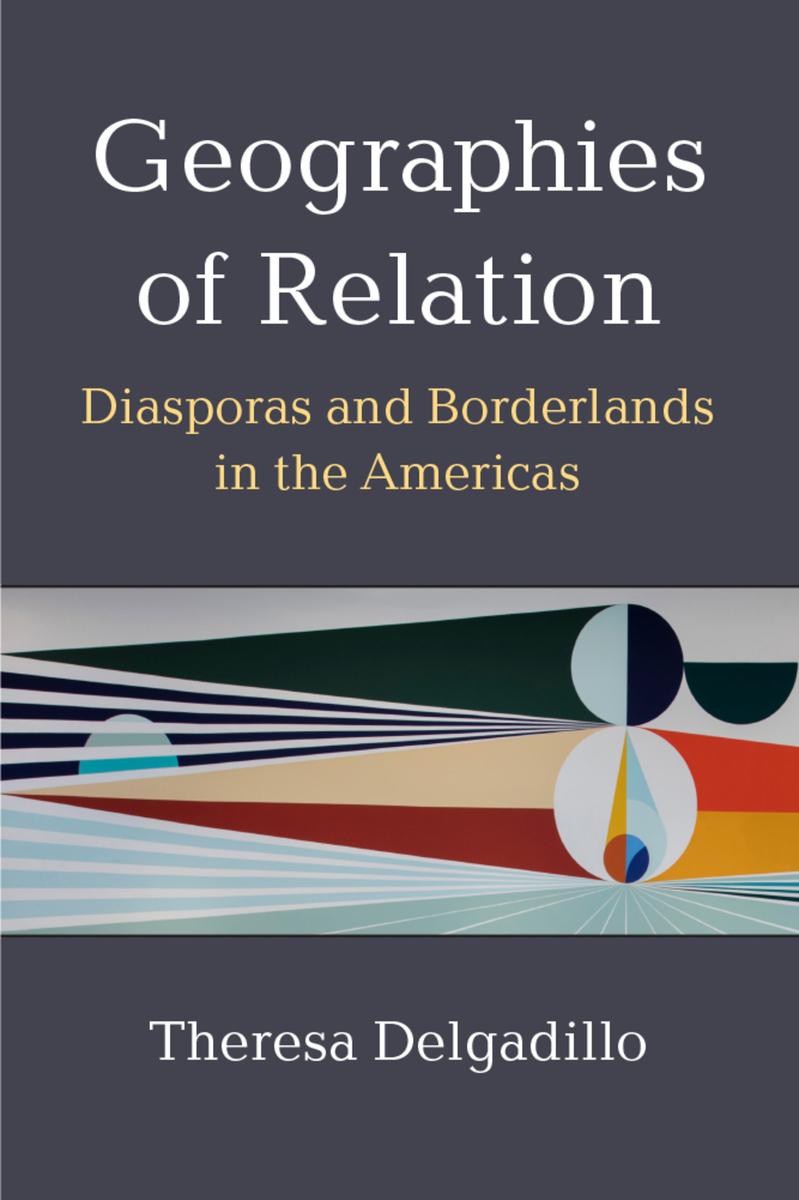
Geographies of Relation: Diasporas and Borderlands in the Americas
Geographies of Relation: Diasporas and Borderlands in the Americas
by Theresa Delgadillo
University of Michigan Press, 2024
ISBNs
Cloth: 978-0-472-07693-2
Paper: 978-0-472-05693-4
eISBN: 978-0-472-90457-0 (OA)
About the Book
Geographies of Relation offers a new lens for examining diaspora and borderlands texts and performances that considers the inseparability of race, ethnicity, and gender in imagining and enacting social change. Theresa Delgadillo crosses interdisciplinary and canonical borders to investigate the interrelationships of African-descended Latinx and mestizx peoples through an analysis of Latin American, Latinx, and African American literature, film, and performance.
Not only does Delgadillo offer a rare extended analysis of Black Latinidades in Chicanx literature and theory, but she also considers over a century’s worth of literary, cinematic, and performative texts to support her argument about the significance of these cultural sites and overlaps. Chapters illuminate the significance of Toña La Negra in the Golden Age of Mexican cinema, reconsider feminist theorist Gloria Anzaldúa’s work in revising exclusionary Latin American ideologies of mestizaje, delve into the racial and gender frameworks Sandra Cisneros attempts to rewrite, unpack encounters between African Americans and Black Puerto Ricans in texts by James Baldwin and Marta Moreno Vega, explore the African diaspora in colonial and contemporary Peru through Daniel Alarcón’s literature and the documentary Soy Andina, and revisit the centrality of Black power in ending colonialism in Cuban narratives. Geographies of Relation demonstrates the long histories of networks and exchanges across the Americas as well as the interrelationships among Indigenous, Black, African American, mestizx, Chicanx, and Latinx peoples. It offers a compelling argument that geographies of relation are as significant as national frameworks in structuring cultural formation and change in this hemisphere.
Not only does Delgadillo offer a rare extended analysis of Black Latinidades in Chicanx literature and theory, but she also considers over a century’s worth of literary, cinematic, and performative texts to support her argument about the significance of these cultural sites and overlaps. Chapters illuminate the significance of Toña La Negra in the Golden Age of Mexican cinema, reconsider feminist theorist Gloria Anzaldúa’s work in revising exclusionary Latin American ideologies of mestizaje, delve into the racial and gender frameworks Sandra Cisneros attempts to rewrite, unpack encounters between African Americans and Black Puerto Ricans in texts by James Baldwin and Marta Moreno Vega, explore the African diaspora in colonial and contemporary Peru through Daniel Alarcón’s literature and the documentary Soy Andina, and revisit the centrality of Black power in ending colonialism in Cuban narratives. Geographies of Relation demonstrates the long histories of networks and exchanges across the Americas as well as the interrelationships among Indigenous, Black, African American, mestizx, Chicanx, and Latinx peoples. It offers a compelling argument that geographies of relation are as significant as national frameworks in structuring cultural formation and change in this hemisphere.
About the Author
Theresa Delgadillo is a Vilas Distinguished Professor of English and Chican@ and Latin@ Studies at the University of Wisconsin-Madison, where she is also Director of the Chican@ and Latin@ Studies Program. She is a founder and editor for the online publication Latinx Talk.
Reviews
"Delgadillo explains that what she terms "geographies of relation" (which encompasses the overlapping space and methods of diaspora and borderlands) reveal silenced histories of interrelationship and open reflection on the combination of racial/ethnic and gendered relationality in the Americas. Summing up: Highly recommended. Graduate students through faculty."— Choice
"Delgadillo’s Geographies of Relation is a marvelous, timely study that will have a foundational impact on the field of Latinx Studies. It offers a compelling and significant cultural analysis of Afro/Latinx creativity and expressive forms and illustrates their transformative importance. Scholars of every discipline will find Geographies of Relation helpful and inspiring."— Mary Pat Brady, Author of Scales of Captivity: Racial Capitalism and the Latinx Child
"Geographies of Relation amplifies mostly silenced histories and dialogues, including hemispheric investments in anti-Blackness within discussions of mestizaje among diaspora and borderlands subjects. This book makes visible the historic investments among diaspora and borderlands subjects that transform anti-Blackness into acts of solidarity and contributes to the study of literature, film, music, and performance that circulate within and across the Americas."— Michelle Habell-Pallan, Author of Loca Motion: The Travels of Chicana and Latina Popular Culture
"A seminal and ground-breaking work of authentic and original scholarship..."— Midwest Book Review
“Theresa Delgadillo's Geographies of Relation: Diasporas and Borderlands in the Americas masterfully combines borderlands and diaspora theorizing to read relationally, across minoritized difference, taking an extremely timely approach grounded in women-of-color feminist theory and Latinx and Black studies…Delgadillo insightfully argues for relational approaches that challenge nationalism and racial exclusions, proposing ”looking sideways" and “intersecting diasporas” as frameworks to achieve “new communities of belonging” in the Americas."
— Modern Language Association Prize Citation
Tags
Hispanic American authors, Black authors, Performing arts, Geographies, African diaspora in literature, Relation, Mestizaje in literature, Diasporas, Caribbean & Latin American Studies, Hispanic & Latino, In literature, Motion pictures, American literature, African American & Black, Media Studies, Latin America, Cultural & Ethnic Studies, History and criticism, Literary Criticism, United States, Social Science, History
Open Access Information
License: CC BY-NC-ND

 Loading...