
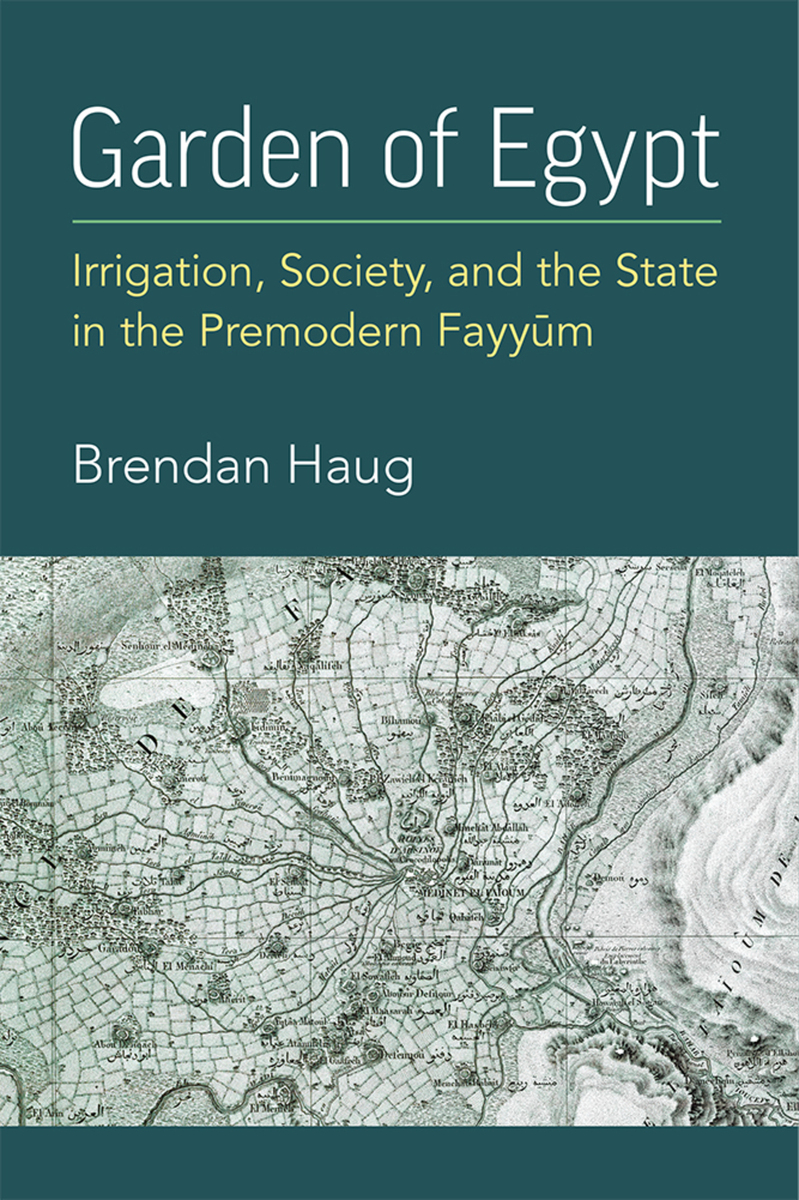
Garden of Egypt: Irrigation, Society, and the State in the Premodern Fayyum
Garden of Egypt: Irrigation, Society, and the State in the Premodern Fayyum
by Brendan Haug
University of Michigan Press, 2024
ISBNs
Cloth: 978-0-472-13352-9
eISBN: 978-0-472-90440-2 (OA)
About the Book
Garden of Egypt: Irrigation, Society, and the State in the Premodern Fayyūm is the first environmental history of Egypt’s Fayyūm depression. The volume studies human relationships with flowing water, from the third century BCE to the thirteenth century CE. Until the arrival of modern perennial irrigation in the nineteenth century, the Fayyūm was the only region of premodern Egypt to be irrigated by a network of artificial canals. By linking large numbers of rural communities together in shared dependence on this public irrigation infrastructure, canalization introduced to Egypt a radically new way of interacting both with the water of the Nile and with fellow farmers. Drawing upon ancient Greek papyri, medieval Arabic literature, and modern comparative evidence, this book explores the ways in which the Nile’s water, local farmers, and state power together continually reshaped this irrigated landscape over more than thirteen centuries. Following human/water relationships through both space and time further helps to erode disciplinary boundaries and bring multiple periods of Egyptian history into contact with one another.
About the Author
Brendan Haug is Archivist of the Papyrology Collection, University of Michigan, and Associate Professor of Classical Studies, University of Michigan.
Reviews
“Garden of Egypt revolutionizes our understanding of water and society in ancient Egypt. Haug grasps the dynamic interactions between humans and the environment in the Fayyūm specifically and more generally in the ancient Roman world.”
— Cynthia Bannon, Indiana University“The book offers a fascinating environmental history of the Fayyūm. Garden of Egypt leads the reader from a panoramic view of the Fayyūm’s waters to a granular, and more embodied one, where ancient voices are allowed to speak for themselves. This book will challenge, expand, and shift conversations on ancient environmental history.”
— Katherine Blouin, University of Toronto
Tags
New Texts From Ancient Cultures, Society, Management, State, Rome, Greece, Ancient, Archaeology, Social Science, History
Open Access Information
License: CC BY-NC

 Loading...