
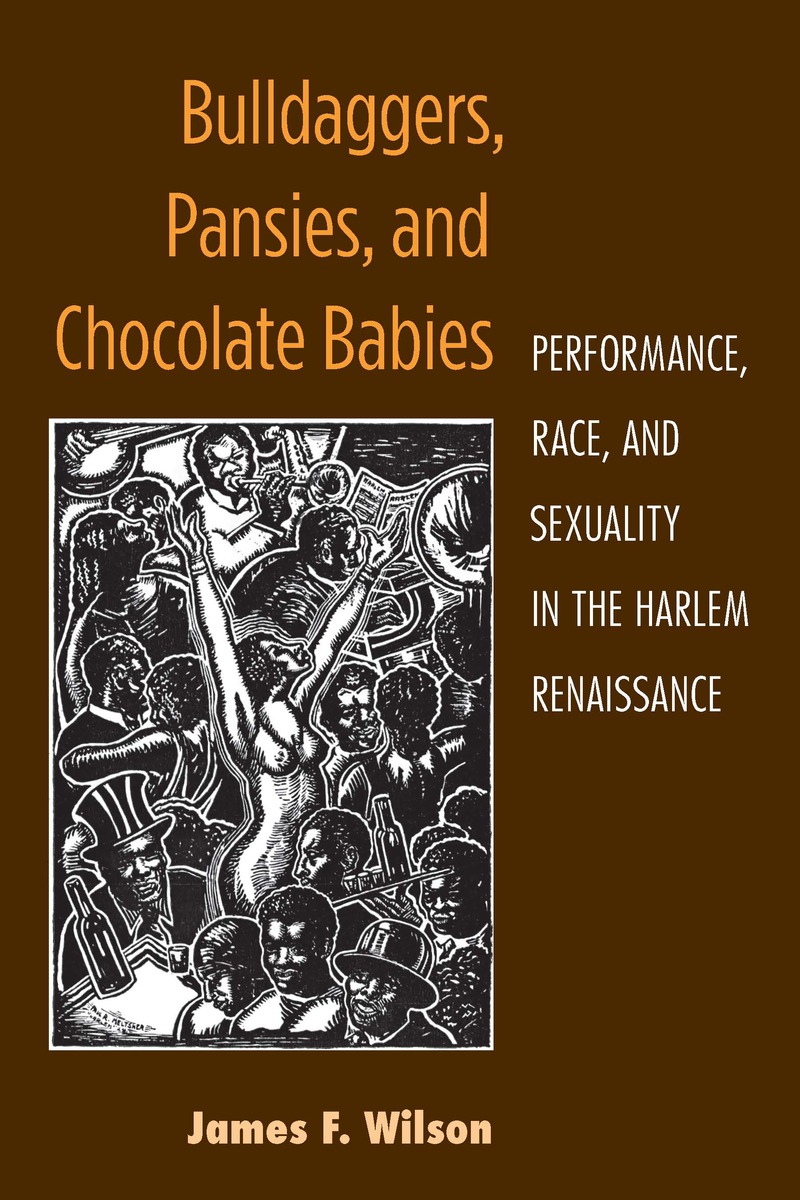
Bulldaggers, Pansies, and Chocolate Babies: Performance, Race, and Sexuality in the Harlem Renaissance
Bulldaggers, Pansies, and Chocolate Babies: Performance, Race, and Sexuality in the Harlem Renaissance
by James F. Wilson
University of Michigan Press, 2011
ISBNs
Cloth: 978-0-472-11725-3
Paper: 978-0-472-03489-5
eISBN: 978-0-472-90404-4 (OA)
eISBN: 978-0-472-02696-8 (standard)
About the Book
Bulldaggers, Pansies, and Chocolate Babies shines the spotlight on historically neglected plays and performances that challenged early twentieth-century notions of the stratification of race, gender, class, and sexual orientation. On Broadway stages, in Harlem nightclubs and dance halls, and within private homes sponsoring rent parties, African American performers of the 1920s and early 1930s teased the limits of white middle-class morality. Blues-singing lesbians, popularly known as "bulldaggers," performed bawdy songs; cross-dressing men vied for the top prizes in lavish drag balls; and black and white women flaunted their sexuality in scandalous melodramas and musical revues. Race leaders, preachers, and theater critics spoke out against these performances that threatened to undermine social and political progress, but to no avail: mainstream audiences could not get enough of the riotous entertainment.James F. Wilson has based his rich cultural history on a wide range of documents from the period, including eyewitness accounts, newspaper reports, songs, and play scripts, combining archival research with an analysis grounded in a cultural studies framework that incorporates both queer theory and critical race theory. Throughout, he argues against the widely held belief that the stereotypical forms of black, lesbian, and gay show business of the 1920s prohibited the emergence of distinctive new voices. Figuring prominently in the book are African American performers including Gladys Bentley, Ethel Waters, and Florence Mills, among others, and prominent writers, artists, and leaders of the era, including Langston Hughes, Wallace Thurman, Zora Neale Hurston, and W. E. B. Du Bois. The study also engages with contemporary literary critics, including Henry Louis Gates and Houston Baker. "James F. Wilson uncovers fascinating new material on the Harlem Renaissance, shedding light on the oft-forgotten gay and lesbian contributions to the era's creativity and Civil Rights. Extremely well researched, compellingly written, and highly informative."
—David Krasner, author of A Beautiful Pageant: African American Theatre, Drama, and Performance in the Harlem Renaissance, 1910-1927
—David Krasner, author of A Beautiful Pageant: African American Theatre, Drama, and Performance in the Harlem Renaissance, 1910-1927
About the Author
James F. Wilson is Professor of English and Theater at LaGuardia Community College, City University of New York.
Reviews
"Scholars across myriad fields will, no doubt, find the book an invaluable resource and teaching tool."
—Isaiah Matthew Wooden, Theatre Journal
— Theatre Journal—Isaiah Matthew Wooden, Theatre Journal
Tags
Triangulations: Lesbian/Gay/Queer/Trans Theater/Dance/Performance, Race in literature, American drama, Harlem (New York N.Y.), Harlem Renaissance, African Americans in the performing arts, Dance, African American authors, New York, New York (State), Gay Studies, LGBTQ+ Studies, Theater, Intellectual life, African Americans, African American & Black Studies, History & Criticism, Performing Arts, Cultural & Ethnic Studies, History and criticism, 20th century, Social Science, History
Open Access Information
Label: Big Ten Academic Alliance
License: CC BY-NC

 Loading...