
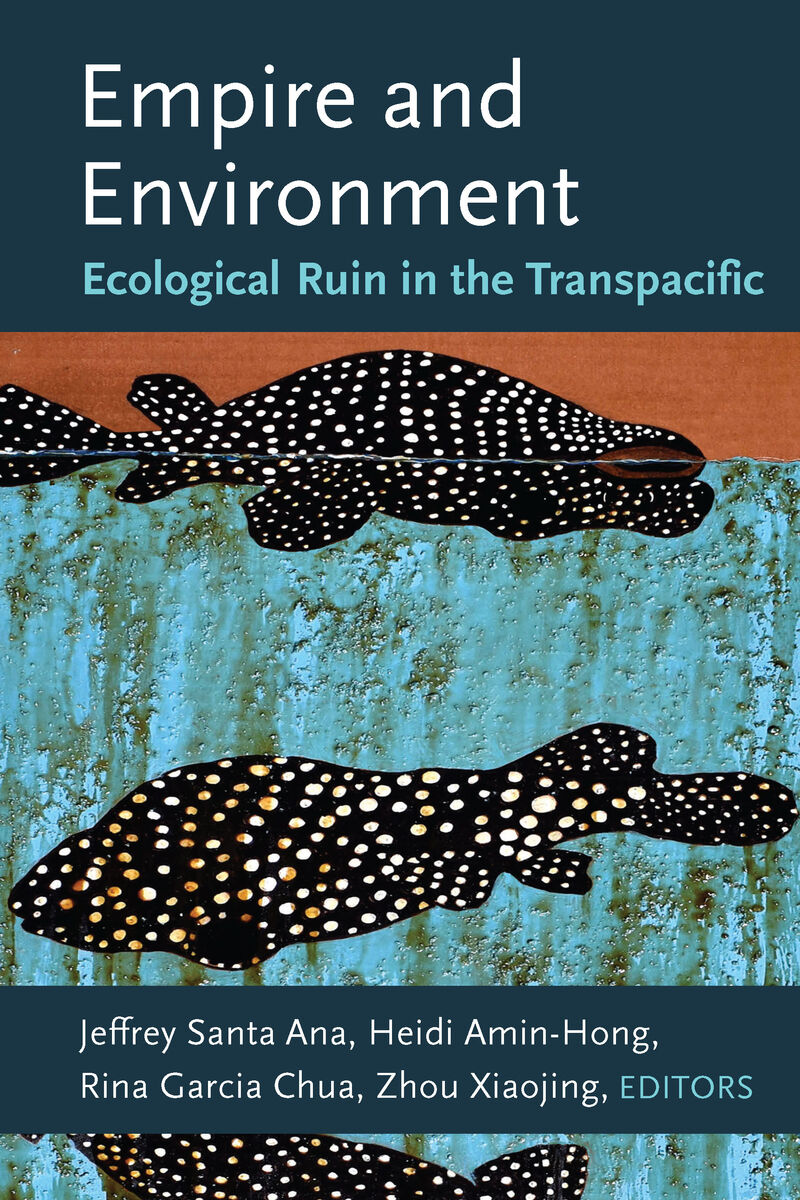
Empire and Environment: Ecological Ruin in the Transpacific
Empire and Environment: Ecological Ruin in the Transpacific
edited by Jeffrey Santa Ana, Heidi Amin-Hong, Rina Garcia Chua and Xiaojing Zhou
University of Michigan Press, 2022
ISBNs
Cloth: 978-0-472-07493-8
Paper: 978-0-472-05493-0
eISBN: 978-0-472-90299-6 (OA)
About the Book
Empire and Environment argues that histories of imperialism, colonialism, militarism, and global capitalism are integral to understanding environmental violence in the transpacific region. The collection draws its rationale from the imbrication of imperialism and global environmental crisis, but its inspiration from the ecological work of activists, artists, and intellectuals across the transpacific region. Taking a postcolonial, ecocritical approach to confronting ecological ruin in an age of ecological crises and environmental catastrophes on a global scale, the collection demonstrates how Asian North American, Asian diasporic, and Indigenous Pacific Island cultural expressions critique a de-historicized sense of place, attachment, and belonging. In addition to its thirteen chapters from scholars who span the Pacific, each part of this volume begins with a poem by Craig Santos Perez. The volume also features a foreword by Macarena Gómez-Barris and an afterword by Priscilla Wald.
About the Author
Jeffrey Santa Ana is Associate Professor of English at Stony Brook University.
Heidi Amin-Hong is Assistant Professor of English at University of California, Santa Barbara.
Rina Garcia Chua is a Jack and Doris Shadbolt Fellow in the Humanities at Simon Fraser University.
Zhou Xiaojing is Professor of English at the University of the Pacific.
Reviews
“Empire and Environment is an important volume with scholarship of the highest quality that will be valuable to scholars and graduate and undergraduate students. The book puts into conversation interdisciplinary and transnational writers, activists, and poetry. The range of artists and scholars gathered together allow for coverage of diverse interests, disciplines, and geographies. It also makes for a dynamic read and will appeal to a variety of readers.”— Marguerite Nguyen, Wesleyan University
"Overall, Empire and Environment: Ecological Ruin in the Transpacific is a valuable addition to the environmental humanities and to postcolonial and decolonial studies. It constellates a commendable breadth of cultural examples from across the Pacific, connecting environmental crises to interconnected critiques of capitalism, colonialism and empire."— Matthew Lear, Green Letters: Studies in Ecocriticism
“Empire and Environment speaks to the urgency of the contemporary political moment and to the long histories of militarization, empire, and extraction that continue to shape transpacific ecologies. It centers the political, literary, and artistic work of Pacific Islanders, diasporic Asians, and Asian North Americans as offering the crucial insights, theories, and resistance that are necessary to developing sustainable and decolonial futures. This is an outstanding, important collection.”— Sarah D. Wald, University of Oregon
"Living up to the promise of their anthology titles, editors Jeffrey Santa Ana, Heidi Amin-Hong, Rina Garcia Chua, and Zhou Xiaojing bring together a heterogenous collection of works not only to consider the ruinous impacts of imperialism and colonialism across the Pacific region, but also to recognize the current and future possibilities of decolonial environmental justice and self-determination. Empire and Environment is certain to be a key interdisciplinary text for those interested in transpacific studies, environmental humanities, ecocriticism, empire and settler colonialism."— Ashanti Shih, H-Net
"With its strategic turn to the Pacific region as the locus of its critique, the book lets emerge often understated transpacific sensibilities, which in turn grants visibility to alternative coalitions that are grounded not only in geographical proximities but also in struggles and worldviews that resonate across the region and beyond. As such, more than articulating of the endurance of imperial debris, Empire and Environment reminds us that among the ruins there also lie possible futures, with marginalized human and nonhuman lives perpetually persisting." — Christian Jil R. Benitez, The Journal of Asian Studies
"By bringing destructive consequences of capitalism into dialogue with ecological destruction across and within the Pacific region, Empire and Environment increases our understanding of the complexities and conflicts of present-day global ecological systems deeply and persistently shaped by histories of colonialism, militarism, extractive imperialism, and racial capitalism."— Hanyue Li, Asian American Literature: Discourses and Pedagogies
Tags
Asian American authors, Decolonization in literature, Environmentalism in literature, Ecocriticism in literature, Pacific Island literature, Transpacific, Empire, Asian American & Pacific Islander Studies, Ecology, American literature, Nature, Cultural & Ethnic Studies, History and criticism, Literary Criticism, Social Science
Open Access Information
Label: Knowledge Unlatched
License: CC BY-NC-ND

 Loading...