
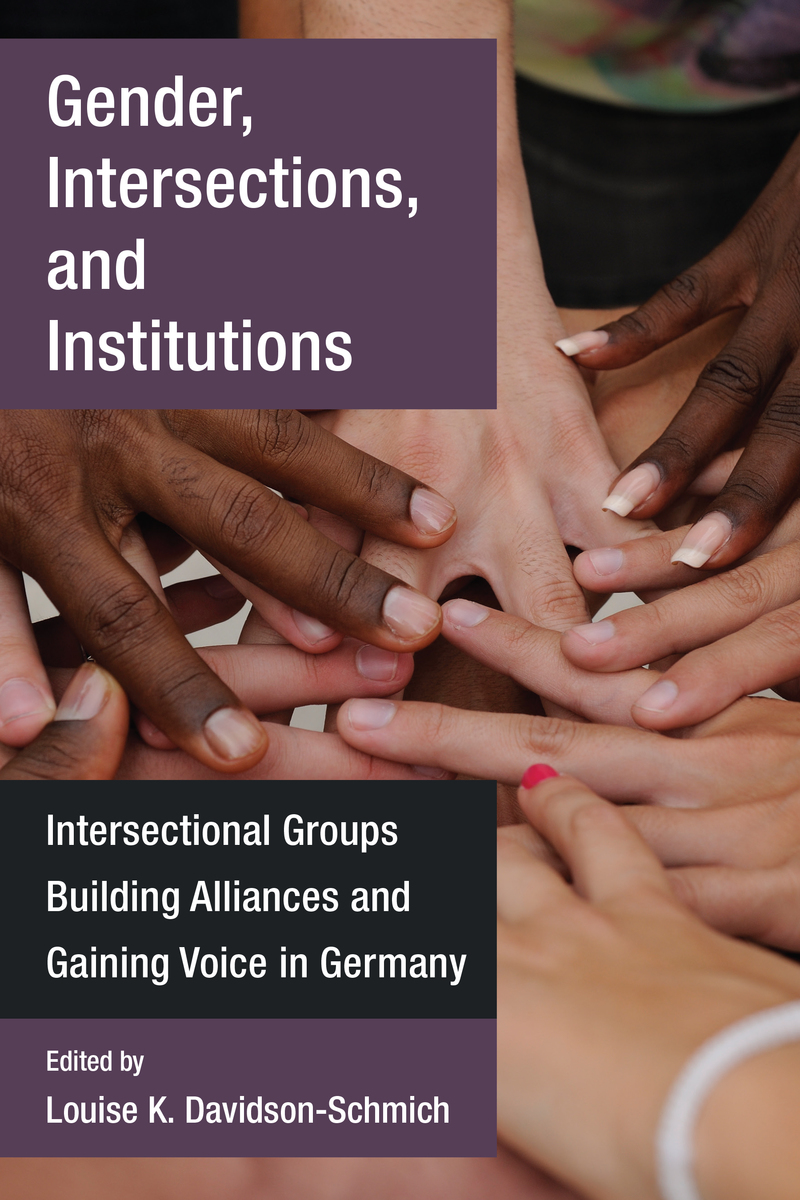
Gender, Intersections, and Institutions: Intersectional Groups Building Alliances and Gaining Voice in Germany
Gender, Intersections, and Institutions: Intersectional Groups Building Alliances and Gaining Voice in Germany
edited by Louise K. Davidson-Schmich
University of Michigan Press, 2017
ISBNs
Cloth: 978-0-472-13053-5
eISBN: 978-0-472-90235-4 (OA)
eISBN: 978-0-472-12321-6 (standard)
About the Book
Germany serves as a case study of when and how members of intersectional groups—individuals belonging to two or more disadvantaged social categories—capture the attention of policymakers, and what happens when they do. This edited volume identifies three venues through which intersectional groups are able to form alliances and generate policy discussions regarding their concerns. Original empirical case studies focus on a wide range of timely subjects, including the intersexed, gender and disability rights, lesbian parenting, women working in STEM fields, workers’ rights in feminized sectors, women in combat, and Muslim women and girls.
About the Author
Louise K. Davidson-Schmich is Professor of Political Science at the University of Miami, and author of Gender Quotas and Democratic Participation: Recruiting Candidates for Elective Offices in Germany (2016).
Reviews
“There is no book which provides an overview of so many different groups and intersections. It makes a unique contribution to the field.”
—Liza Mügge, University of Amsterdam
“A great addition not only to intersectional studies, but to the literatures on social/political/legal mobilization, and the comparative study of diversity issues . . . an excellent volume.”
—Jackie Gehring, University of California, Santa Cruz
— -—Liza Mügge, University of Amsterdam
“A great addition not only to intersectional studies, but to the literatures on social/political/legal mobilization, and the comparative study of diversity issues . . . an excellent volume.”
—Jackie Gehring, University of California, Santa Cruz
“Intersectionality is a term that is thrown into a lot of gender studies, but this work is the first I have seen that applies this construct in a consistent, logically structured fashion. . . . The case studies are very well chosen, and the types of intersectional marginalization they represent open the door to many future comparative research investigations.”
—Joyce Mushaben, University of Missouri–St. Louis
— -—Joyce Mushaben, University of Missouri–St. Louis
“A dynamite collection of expert authors have coordinated a set of eight fascinating case studies to help explain why Germany, generally considered conservative in its family and gender policies, nonetheless adopted measures supportive of weak subgroups of marginalized gender positions. This glaring policy contradiction is shown here to reflect strategic use of different opportunities for leverage and suggests a range of ways to make intersectionally disadvantaged groups heard.”
—Myra Marx Ferree, University of Wisconsin
— -—Myra Marx Ferree, University of Wisconsin
Tags
Pressure groups, 1990-, Intersections, Intersectionality (Sociology), Civil rights, Gender, Gay Studies, Political activity, LGBTQ+ Studies, Germany, Gender Studies, World, Political aspects, Public Policy, European, Politics and government, Political Science, Social Science
Open Access Information
License: CC BY-NC-ND

 Loading...