
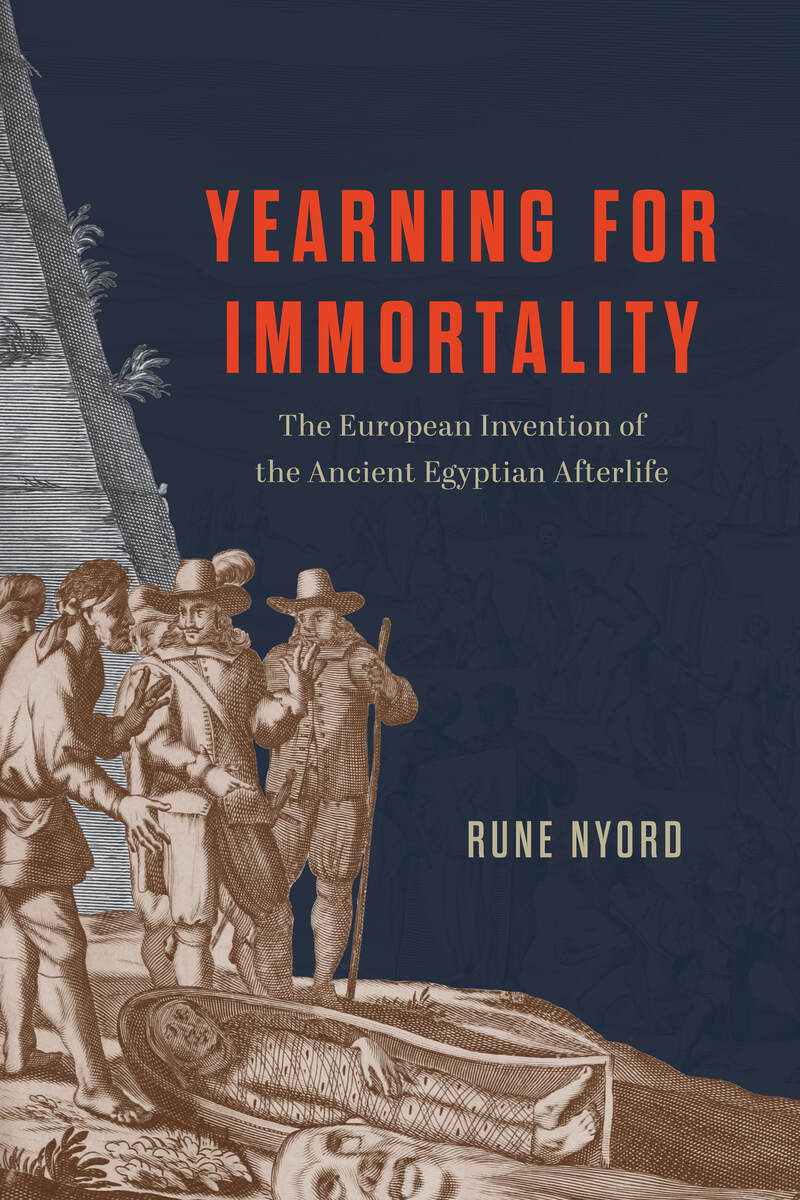
Yearning for Immortality: The European Invention of the Ancient Egyptian Afterlife
Yearning for Immortality: The European Invention of the Ancient Egyptian Afterlife
by Rune Nyord
University of Chicago Press, 2025
ISBNs
Cloth: 978-0-226-83823-6
Paper: 978-0-226-83825-0
eISBN: 978-0-226-83824-3 (all)
About the Book
How our understanding of the ancient Egyptian afterlife was shaped by Christianity.
Many of us are familiar with the ancient Egyptians’ obsession with immortality and the great efforts they made to secure the quality of their afterlife. But, as Rune Nyord shows, even today, our understanding of the Egyptian afterlife has been formulated to a striking extent in Christian terms. Nyord argues that this is no accident, but rather the result of a long history of Europeans systematically retelling the religion of ancient Egypt to fit the framework of Christianity. The idea of ancient Egyptians believing in postmortem judgment with rewards and punishments in the afterlife was developed during the early modern period through biased interpretations that were construed without any detailed knowledge of ancient Egyptian religion, hieroglyphs, and sources.
As a growing number of Egyptian images and texts became available through the nineteenth century, these materials tended to be incorporated into existing narratives rather than being used to question them. Against this historical background, Nyord argues that we need to return to the indigenous sources and shake off the Christian expectations that continue to shape scholarly and popular thinking about the ancient Egyptian afterlife.
Many of us are familiar with the ancient Egyptians’ obsession with immortality and the great efforts they made to secure the quality of their afterlife. But, as Rune Nyord shows, even today, our understanding of the Egyptian afterlife has been formulated to a striking extent in Christian terms. Nyord argues that this is no accident, but rather the result of a long history of Europeans systematically retelling the religion of ancient Egypt to fit the framework of Christianity. The idea of ancient Egyptians believing in postmortem judgment with rewards and punishments in the afterlife was developed during the early modern period through biased interpretations that were construed without any detailed knowledge of ancient Egyptian religion, hieroglyphs, and sources.
As a growing number of Egyptian images and texts became available through the nineteenth century, these materials tended to be incorporated into existing narratives rather than being used to question them. Against this historical background, Nyord argues that we need to return to the indigenous sources and shake off the Christian expectations that continue to shape scholarly and popular thinking about the ancient Egyptian afterlife.
About the Author
Rune Nyord is associate professor of ancient Egyptian art and archaeology at Emory University. He is the author of Breathing Flesh: Conceptions of the Body in the Ancient Egyptian Coffin Texts and Seeing Perfection: Ancient Egyptian Images Beyond Representation, and he has edited or coedited several anthologies.
Reviews
“Yearning for Immortality is groundbreaking. Carefully examining the foundations of beliefs about the ancient Egyptian afterlife, Nyord brings a desperately needed critical lens to the history of Egyptology. Nyord argues that ancient findings were made to fit into preexisting narratives, and he makes the convincing and unsettling case that contemporary ways of understanding the ancient Egyptian afterlife carry on the flawed and remarkably insidious frameworks developed before the decipherment of hieroglyphics. This book shows that the current paradigm is in a moment of crisis and in dire need of reexamination, critique, and ultimately replacement.”
— Margaret Geoga, The University of Chicago“Nyord offers a proposal for revising the way we think about ancient Egyptian funerary religion, presenting fresh ways of looking at the subject. Addressing the assumption that ancient Egypt was a society obsessed with death and eternal life, Yearning for Immortality considers how ideas of ancient Egyptian afterlife were created and traces how these ideas became deeply rooted throughout the centuries. Nyord’s is an important argument for contemporary Egyptology, for scholars working on the reception of ancient Egypt (and antiquity more widely), and for the fields of religious and mortuary studies.”
— Stephanie Moser, University of Southampton“Nyord provides an intricate account of how Egyptian mortuary practices have been transformed in the Western imagination to fit Christian archetypes. . . . Exploring why Western misinterpretations of ancient Egyptian death practices persist, the author points to an enduring ‘universal human longing for transcendent, eternal life,’ as well as documentaries, film exhibits, and books that reinforce entrenched ideas about the Egyptian quest for immortality. Dense and methodical, Nyord's history meticulously probes the challenges of cultural transmission. Serious Egyptologists will be edified.”
— Publishers Weekly"In the tradition of the best books—notably Christina Riggs’ 2014 Unwrapping Ancient Egypt, which [Yearning for Immortality] references—this will make uncomfortable reading for many. The approach taken is relatively uncommon in Egyptology: critiquing (and successfully undermining) significant received wisdom, while at the same time pointing to fresh interpretation of the indigenous sources. . . . Likely to quickly become essential reading for students of Egyptian religion."
— Ancient Egypt"Despite the familiarity of ancient Egypt’s human mummies, how to interpret the culture’s attitude to immortality is still controversial. Egyptologist Rune Nyord analyses European ideas about ancient-Egyptian mortuary religion, 'construed in terms of a belief in a personal afterlife.' He notes that early scholars considered it as fitting a Christian framework. This erroneous perception persisted even after the hieroglyphs were deciphered in the nineteenth century. Nyord argues that it must be corrected, drawing on hieroglyphic sources."
— Nature"Rune Nyord’s Yearning for Immortality consists of a major step forward in the decolonization of the study of ancient Egypt."
— Rennan Lemos, Antiquity, Department of Archaeology, University of Durham
Tags
Egyptology, Egyptian, Ancient, Religion, History
Open Access Information
License: CC BY-NC-ND

 Loading...